Dr. Abdul El-Sayed’s victory in the Democrats’ U.S. Senate primary in Michigan last Tuesday was the latest sign of an emerging kingmaker in U.S. politics – a little-known super PAC that has tapped the wealth of a new cadre of Muslim-American mega-donors to support far-left candidates.
Since it was launched just six months ago, American Priorities has channeled millions of dollars, primarily from donors with Arab, Muslim, and/or Middle Eastern backgrounds, to a string of winning candidates in high-profile races.
Most of the entity-supported candidates are running on various democratic-socialist policies, such as single-payer health care, abolishing ICE, and slashing the military. But one area in which all candidates are aligned, consistent with the PAC’s mission, is in their antagonism towards Israel.
With several such candidates considered locks for the U.S. House in deep blue districts and potentially Michigan’s Senate seat in November, the independent expenditure vehicle is at the forefront of an increasingly politically influential and growing Muslim-American community – one that has ascended as the Israeli-Palestinian Arab conflict has become a central U.S. political issue following Hamas’ massacre of 1,200 Israelis on October 7, 2023.
In some ways, this is a very American story: As new groups of immigrants establish themselves in America, they eventually seek room for their voice in politics and culture. The key issues that have mobilized Muslim-Americans and the positions held by associated organizations, however, are seen by some as radical. Polls show such voters are significantly more hostile towards Israel and Jews, and tolerant toward groups and ideas the U.S. government has linked to terrorism than the general public – views reflected by the insurgent crop of leftist candidates they are increasingly backing.
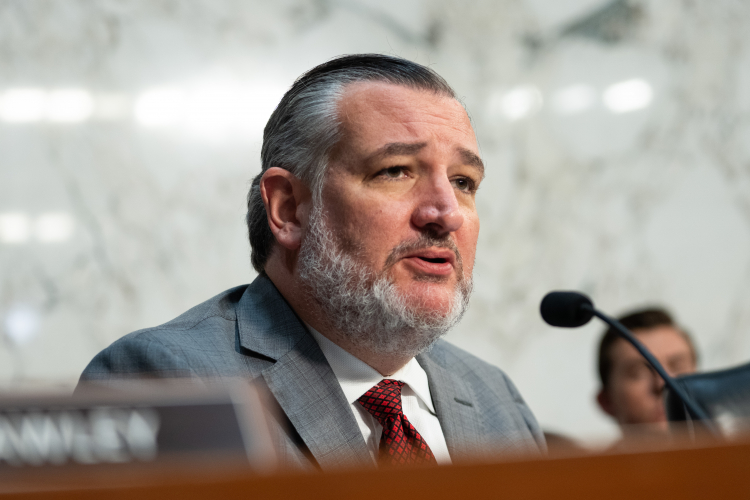
A recent Senate Judiciary Committee hearing convened by Sen. Ted Cruz raised a more chilling issue. The Texas Republican alleged, and witnesses concurred that – in a parallel to what has transpired in countries like France, Germany, and the United Kingdom – the Muslim Brotherhood, a subversive transnational Islamist organization, has cultivated an “entrenched institutional network” in America of NGOs, advocacy groups, and political organizations to advance its leaders’ recorded mission to “destroy … Western civilization from within.” That network, terrorism expert Kyle Shideler found, has actively partnered with the Democratic Socialists of America, as part of what Cruz called a “Red-Green Alliance,” that Shideler said is “united around a revolutionary objective advocating for the overthrow of the U.S. Constitution.” Democrats on the panel boycotted the hearing in protest, claiming in a statement the Texas senator was “[s]capegoating Muslims.”
While such partisan conflicts simmer, Muslim-Americans, who represent meaningful percentages of the population in dark blue New York and purple Michigan alike, are buoying the leftists increasingly dominating the Democrat Party. All indications are that this bloc is positioning itself not only to play an outsize role in shaping the next Congress but also in defining the 2028 presidential contest and America’s future.
Pro-Palestinian Leftists
American Priorities was founded in February as a self-styled “countervailing force” to the American Israel Public Affairs Committee (AIPAC). Though the largest such group, it is just one of several relatively new PACs with overlapping donors centered on opposition to Israel (see sidebar). The super PAC is led by Hannah Fertig, a strategist self-identifying as Jewish who figured prominently in the 2020 presidential campaign of Bernie Sanders, who is also Jewish and a backer of staunch anti-Zionist candidates. The group’s treasurer is Mark Hanna, an assembly district leader in New York who began his political career as an organizer focusing on Muslim-related issues, including through forming Yalla Brooklyn, an NGO dedicated to mobilizing Arab and Muslim voters. American Priorities has pledged to put up $10 million this cycle to elect Democratic candidates who believe the party establishment is too pro-Israel. AIPAC and its affiliates have also poured tens of millions of dollars into recent election cycles as support for the Jewish state generally has declined – a long–term trend among Democrats correlating with the rise of the anti-Israel progressive left. To support its political claims, American Priorities cites polls showing a majority of Democratic voters oppose U.S. military aid to Israel, are more sympathetic to Palestinian Arabs than Israelis, and shun candidates who accept AIPAC support.
Many of the super PAC’s top donors are first-generation Muslim immigrants who have made their fortunes in the U.S. They include:
- Hussein “Sam” Mahrouq, who was born in a Palestinian refugee camp in Jordan, and later grew a single car dealership in Texas into Mahrouq Enterprises International, a conglomerate encompassing 25 companies, spanning 3 continents, and employing more than 650 people across the automotive, technology, and real estate sectors.
- Idris and Haroon Mokhtarzada, brothers who, as children, fled Afghanistan with their family amid Russia’s invasion before settling in the U.S., became serial entrepreneurs, most notably founding the personal finance app Truebill in 2015 – which, six years later, was sold to Rocket Companies for $1.275 billion and became today’s Rocket Money.
- Nazar Khan, born in India and who likewise immigrated to the U.S. as a child, commenced a journey that would take him from the University of Pennsylvania to the perch where he sits today as co-founder and chief technology officer of AI energy infrastructure developer and operator Tera Wulf, valued at around $9 billion.
These are highly successful immigrants who, by all accounts, have lived the American dream. Nevertheless, the super PAC they have written six-figure checks to is partnered with groups advocating far-left social and economic policies aimed at fundamentally transforming America, including Justice Democrats, the Working Families Party, Leaders We Deserve, and the IMEU Policy Project.
RealClearInvestigations could not reach or did not receive responses to a series of questions posed to Mahrouq, the Mokhtarzada Brothers, Khan and other top American Priorities donors about their views.
For his part, Mahrouq told CNN in connection with a July 2026 report that he believes in “a U.S. foreign policy in the Middle East that respects the dignity of all people in the region.”
“My focus is not partisan politics, but rather promoting policies that strengthen America, encourage opportunity, and serve the interests of American citizens. I believe decisions affecting our country should be made based on what is best for the United States, independent of pressure from any foreign government, foreign interest group or partisan agenda,” he told Jewish Insider via a spokesperson earlier this year.
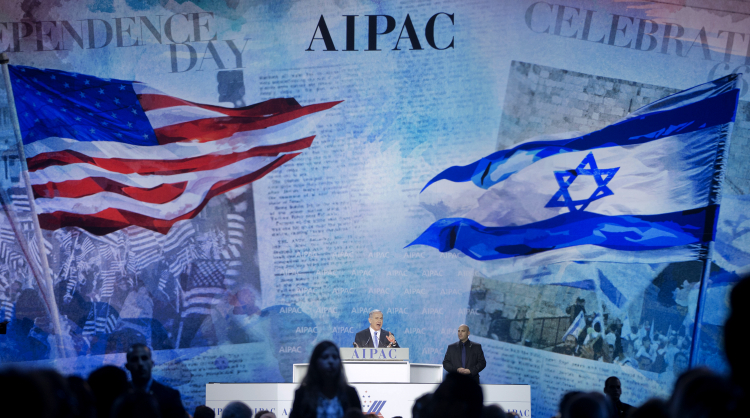
Some on the right in the U.S. and Israel alike have advocated for phasing out aid — on good faith grounds that it would redound to both countries’ benefit.
In contrast to those boosters of the U.S.-Israel relationship, nearly every candidate backed by American Priorities has characterized Israel as an “apartheid” state engaged in “genocide” in Gaza, downplayed or rationalized the violence of its jihadist foes, and disparaged their primary opponents by accusing them of being “bought and paid for,” directly or indirectly, by the Jewish state.
Some of the candidates it has supported thus far – many of which its donors have also contributed to individually – include:
- Abdul El-Sayed, the Democrat’s candidate for U.S. Senate in Michigan, boosted by $678,000 of support from American Priorities. An Egyptian-American, during the Arab Spring in 2012 he signed a letter backing Egyptian president and Muslim Brotherhood leader Mohamed Morsi against his opponents. In 2022, he compared a proposed ballot measure in Oklahoma prohibiting judges from considering Islamic law in rulings to “the Trail of Tears,” which followed comments in 2021 in which he drew equivalence between the War on Terror and “the decimation of Native Americans, the Transatlantic Slave Trade, Jim Crow segregation, [and] Japanese interment (sic).” He refused to address the U.S. military’s assassination of Iran’s Supreme Leader – who had authorized the killing of perhaps 42,000 Iranian protesters in February – so as not to inflame the many “people in Dearborn [Michigan] who are sad.” This past spring he also suggested that a jihadist attack on random members of a West Bloomfield, Michigan, synagogue in March made sense on one level because several of the attacker’s family members – including a brother who was a commander of the terrorist group – had been killed by Israeli strikes in Lebanon. El-Sayed frequently appears with the antisemitic, terror-sympathizing, and Mao-revering streamer Hasan Piker, dismissing criticism of Piker’s assertion that “America deserved 9/11,” as an example of “cancel culture.” El-Sayed’s father-in-law, Jukaku Tayeb, a $200,000 contributor to a super PAC backing his son-in-law, has reportedly served on the founding committee of the Islamic Society of North America (ISNA) since at least 2007. ISNA was identified as an unindicted co-conspirator in the then-largest terrorism financing case in U.S. history, concerning the Hamas-funding “charity,” the Holy Land Foundation. The organization emerged from the Muslim Brotherhood, which has also helped birth Hamas and other jihadist groups have emerged. El-Sayed previously served as vice president of the University of Michigan chapter of the Muslim Students’ Association (MSA), an organization with Brotherhood roots that helped birth ISNA. He made his “Trail of Tears” remarks in front of the Council on American-Islamic Relations’ Oklahoma chapter. The candidate has spoken before the national organization at multiple events. CAIR, another unindicted co-conspirator in the Holy Land Foundation case, has been designated as a terrorist organization in several Arab countries along with the states of Florida and Texas. Fox News reported that some 41 individuals linked to CAIR have contributed over $115k to El-Sayed. Sen. Cruz and the witnesses collectively identified each of these entities – ISNA, Muslim Students Associations, and CAIR – as part of what Cruz called an “entrenched institutional” Muslim Brotherhood that sits “[b]ehind El-Sayed’s political rise.”
- Dr. Adam Hamawy, the Democrat’s nominee for Congress in New Jersey’s 12th District, boosted by $1.5 million of support from the super PAC – slightly more than he raised from all direct contributors as of this writing. As a young man, an Egyptian-American future plastic surgeon sat in on the lectures of, traveled with, and served as a translator for the “Blind Sheik,” Omar Abdel-Rahman. In 1995, Dr. Hamawy would testify, potentially untruthfully, on his behalf during the terrorism trial linked to the first World Trade Center bombing that resulted in the cleric’s conviction for, among other things, conspiring to bomb six New York landmarks. A year prior, he volunteered as a doctor in Bosnia during the height of the jihadist insurgency there, under the auspices of an NGO in the Benevolence International Foundation subsequently identified as an Al-Qaeda front group. Most recently, he served for several weeks in 2024 at Gaza’s European Hospital, which he called “a completely benign civilian hospital with no tunnels underneath it” – only to be disproven when Israeli forces identified a military base underneath the facility and eliminated senior Hamas leaders operating there, including commander Mohamed Sinwar, brother of October 7 mastermind Yahya Sinwar. Like El-Sayed, Hamawy has defended Piker’s 9/11 comments, stating, “I think we have to put it all in perspective,” and that “I still love the guy.”
- Daria Avila Chevalier, the Democrat’s nominee for Congress in New York’s 13th District, boosted by $1.3 million of support from the super PAC, including spending in opposition to her primary opponent – matching what she raised from all direct contributors as of this writing. A self-described “working-class Dominican New Yorker who has been organizing in upper Manhattan for a fairer, more equitable, and more affordable New York City since she was a teenager,” Chevalier joined an anti-Israel protest in Times Square on Oct. 8, 2023, where participants openly celebrated Hamas’ atrocities from the day before. While an undergraduate, she co-founded the Columbia University Apartheid Divest group, which has endorsed the “total eradication of Western civilization;” she later led the anti-Israel and antisemitic takeover of the campus after the Hamas attack. Chevalier converted to Islam, she says, as a byproduct of her experience interning in Nablus and being surrounded by Muslim activists. The Democrat nominee, who is said to have “oriented her whole adult life around” Palestinian activism, tweeted that “Israel doesn’t exist” amid a series of since-deleted posts.
Democrat Establishment Fears Antisemitic Takeover
Opponents see such candidates’ anti-Zionism as ultimately indistinguishable from antisemitism, with their rhetoric aimed at demonizing and delegitimizing a free and democratic Jewish state. They hear the AIPAC attacks as dog whistles for age-old tropes about cabals of wealthy Jews controlling policymakers, and as insinuating Jewish dual loyalty – ginning up Jew-hatred and sowing domestic discord.
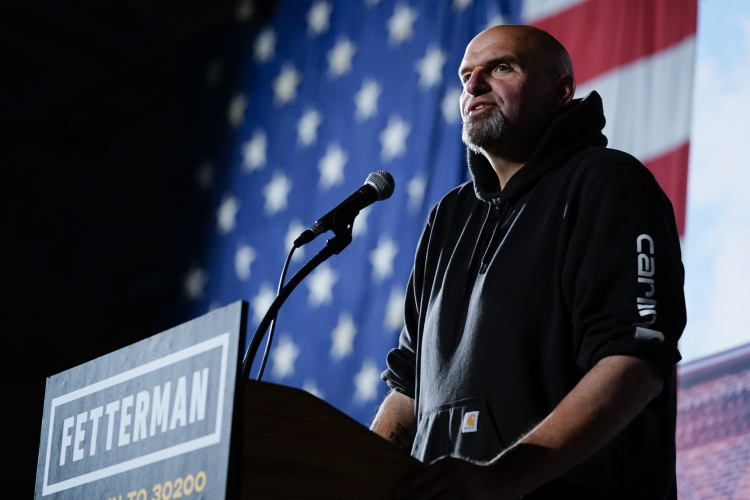
Pennsylvania Democrat Sen. John Fetterman has been perhaps the seniormost party official to make this case, indicating “I’m deeply alarmed by the way the Democratic Party is going after Israel and allowing just rank anti-Semitism to just flourish, you know, on the left and on the campuses too.”
His lower-chamber colleague, Jewish New Jersey Rep. Josh Gottheimer, one of the few other non-lame ducks in Congress to speak out, recently wrote in the Free Press that “Abdul El-Sayed’s victory…is only the latest evidence that my party is being overrun by antisemitism.”
Joel Rubin, the Jewish outreach leader on Bernie Sanders’ 2020 presidential campaign, has likewise said that “I think what Sanders and the Sanders operation have done is shove into our system the most categorically anti-Israel, antisemitic candidates that we’ve seen in a generation – if ever, certainly within the Democratic Party” – a reference to the Vermont socialist’s leadership on the left.
Outgoing New York Rep. Dan Goldman expressed similar concerns. A noted progressive who is Jewish, Goldman’s primary contest came to be defined in part by his pro-Israel positions and AIPAC ties, which his Jewish opponent, American Priorities-endorsed Brad Lander, seized on critically, en route to a 66-34 trouncing of the former Trump impeachment manager. Lander, like many left-wing Reform Jews, has argued that his progressive principles flow from his faith. In contrast to Goldman, speaking before a Queens mosque in May, Lander told worshippers that Israel is committing “genocide in Gaza” and “potentially” in Lebanon, vowing to cut military assistance and partner with the likes of anti-Israel Muslim Reps. Rashida Tlaib and Ilhan Omar in Congress. The former New York City comptroller also disavowed AIPAC and pressed Goldman to sign a pledge to avoid taking such outside political support. An event in the waning days of the campaign illustrated its tenor. Goldman patronized a Brooklyn coffee shop owned by an activist. Upon realizing it had served him, the cafe wrote in a public social media post that it does not serve “genocide enablers,” and it would have turned him away had it known. “[W]e don’t need your money (it’s probably coming from AIPAC anyways),” the since-deleted diatribe read. In Goldman’s concession speech, he lamented that “antisemitic tropes and stereotypes, some of which I heard personally on this campaign, will ultimately be the undoing of our democracy if we all don’t lean in and speak out – even if it’s not politically expedient.”
In advance of a recent failed House vote forced by renegade Republican Rep. Thomas Massie to cut foreign military assistance to Israel, Rep. Adam Smith, the ranking Democrat on the House Ways and Means Committee, decried the “tactics used by those on the far left to advocate for cutting off aid to Israel,” indicating he had had his home “vandalized,” his driveway set on fire, and that a staffer had been “physically assaulted.” Smith revealed this intimidation campaign in a post explaining why the avowed “supporter of Israel” would nevertheless be voting in favor of the amendment. Nearly half of House Democrats – more than 100 in all – joined him, in a marked historical shift. Rep. Massie, the sole Republican to vote in favor of the amendment, is one of the few GOP members to receive direct or indirect contributions from American Priorities supporters, alongside anti-Israel former Rep. Marjorie Taylor Greene.
Dana Nessel, the Democratic attorney general in Michigan – and first Jewish American to hold that post – has raised similar concerns. She recently indicated at an event organized by the Anti-Defamation League that she will not attend her party’s next convention, after a prior one resulted in its selection of a pro-Hezbollah candidate over a pro-Israel Jewish incumbent for Michigan University regent, and attendees heckled El-Sayed primary opponent Rep. Haley Stevens. “I don’t feel safe going,” she said.
“I have profound fears about what is going to happen to this state, and what is going to happen to this country if we don’t have a significant change of course,” she added.
For their part, most of the American Priorities-supported and adjacent candidates have denied that they are antisemites, claiming instead that there is a distinction between Jews, the Jews’ ancestral and biblical homeland where nearly half of the Jewish people live today, and its Jewish leaders. “AIPAC and Israel are not the same as Judaism and the Jewish people,” El-Sayed has said. “I love Judaism, and I love the Jewish people…And the single most dangerous thing that they’ve tried to tell us is that somehow they can extend the definition of anti-Semitism to include a foreign government and its leaders.” Virtually every candidate has likewise run on some variation of the argument that, as El-Sayed put it in a recent interview, “we send our money abroad to Israel to drop bombs on other people’s kids. That money should be spent here at home.” The Michigander has also called for cutting aid specifically to Egypt, Saudi Arabia, and the UAE – all countries that have designated the Muslim Brotherhood as a terrorist organization.
The Mamdani Effect
These candidates are following in the footsteps of, and in some cases with the blessing of, New York Mayor Zohran Mamdani – whose rise captured the attention and support of several of American Priorities’ donors prior to its launch, including its two biggest backers, Mohamed Waqas Javed and Omer Hasan. Both have contributed over $1 million to the super PAC to date. While little is publicly known about them, they and a third donor, Tariq Afaq Ahmed, who has contributed $500,000, were pre- and post-IPO employees at AppLovin, today one of the world’s most valuable ad tech companies, from which they likely made a fortune. AppLovin has come under scrutiny for, among other things, its funding from Chinese Communist Party-linked individuals and entities. Javed and Hasan burst onto the scene as power players when they each contributed $250,000, the largest such donations, to New Yorkers for Lower Costs, an independent expenditure vehicle supporting Mamdani’s election. Ahmed would contribute $25,000 to the mayor’s campaign.
In the final hours of the Democrat primary, brothers Haroon and Idris Mokhtarzadeh would donate $189,000 to Mamdani. Haroon has created Islamic-centric businesses and participated in explicitly Muslim business forums, and sits on the board of the likes of Israel–hostile Mehdi Hasan’s Zeteo, and Drop Site News, co-founded by jihad-sympathetic journalist Jeremy Scahill. His brother Idris has taken a lower profile, albeit likewise seeking to promote Muslim businesses through his involvement in Collective Continuum, a group that aims to “empower 1,000 Muslim-led ventures by 2030.”
American Priorities’ treasurer, Hanna, previously served alongside Mamdani in the 2017 campaign of Palestinian-American Rev. Khader El-Yateem. Mamdani said that El-Yateem “transformed” his life, in part by connecting him with “a political movement that understood Palestine as being a central part of the struggle, which is something that I had often struggled with…all of these politicians I had admired…found every way to not address Palestinians when it came to their seemingly universal struggles.”
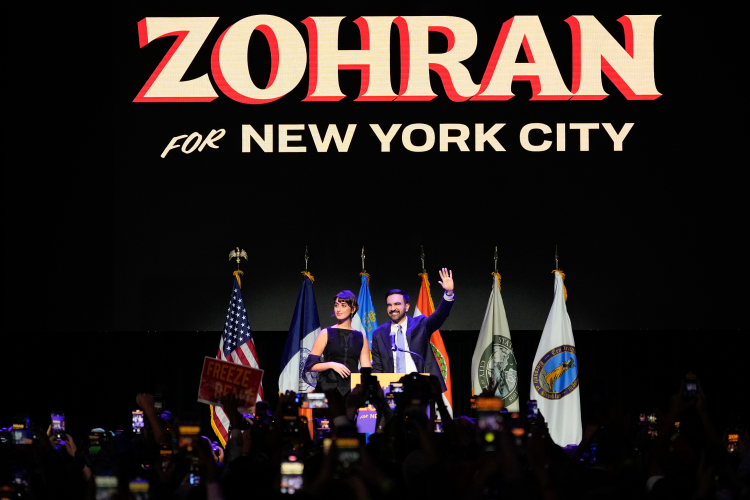
The Mamdani campaign, which emerged from the city’s Muslim Democrat establishment and made Israel and the Palestinian Arabs a major focus, appears to have catalyzed Muslim donors nationally, while demonstrating a proof of concept for how targeted contributions could dramatically increase their political clout going forward.
“After Mamdani’s upset victory over the presumed favorite, [former Gov. Andrew] Cuomo, some of those who supported Mamdani told ABC News they felt their contributions toward his victory could forecast a rise in a larger network of Muslim Americans fundraising in national politics, which they say might influence who will run, and who might win,” the outlet reported at the time.
Ahmed, the former AppLovin employee turned angel investor, called the groundswell of national Muslim support behind Mamdani perhaps “the infancy of something to come.”
Palestinian Cause Binds American Muslims and the Left
The Israel-Palestinian conflict is seen as a unifying issue among a Democrat–aligned but ideologically heterodox Muslim American community estimated at somewhere between 3.5 (by Pew) and 8 million (by CAIR) – 60% of whom are immigrants. Writing in City Journal, Zainab Al-Suwaij, co-founder of the American Muslim League, says that for her co-religionists “the Israel-Palestine conflict has become a defining aspect of their identity, though it directly affects only a tiny portion of the community. No one assumed that all Catholics supported the IRA. By contrast, the Palestinian cause attracts millions of Muslim Americans who have nothing to do with the conflict, but who have been told by clerics, community leaders, and professors to think of it as a religious duty.” The war in Gaza ranked as the second most important issue for American Muslims after the economy, at 35%, according to a 2025 Institute for Social Policy & Understanding poll. Likewise, a survey of Muslim-American voters in the 2024 election produced by CAIR found that of all Muslim-related foreign policy issues during that cycle, the most important one to respondents was “Israeli Genocide.”
Suwaij made her assertion in response to polling of Muslim Americans commissioned by her organization. That survey found that among respondents, some 66% support the Muslim Brotherhood, 35% support Hamas, and 17% harbor unfavorable views towards Jews. The Hamas figures dovetail with a Pew poll indicating 44% support among American Muslims – in line with polling of Palestinian Arabs themselves.
Ahmed Fouad Alkhatib, leader of the Atlantic Council’s Realign for Palestine project, says, “Based on countless interactions, trends, and observations since October 7, this number is almost certainly an undercount.” Like Suwaij, he has written that “Many parents import rigid political narratives from their countries of origin and pass them to their children, leaving first‑ and second‑generation Muslim Americans trapped between inherited dogma and their own attempts to think more broadly. The near-absence of healthy institutional infrastructure then reinforces that foundation. National organizations like CAIR, AMP [American Muslims for Palestine], SJP [Students for Justice in Palestine], and MSA have filled the vacuum with grievance‑based politics, enforced conformity, and a culture where dissent is punished as betrayal.” Sen. Cruz and his witnesses also assessed that, like CAIR and MSA, AMP and SJP are Muslim Brotherhood-linked. Shideler, during the Cruz-led hearing, likewise identified Emgage PAC, the self-described largest Muslim American PAC, as linked to the Brotherhood’s U.S. network, noting it “was created by a former CAIR member who at one time was on a terror watch list, and was also a consultant to convicted terrorist Sami al-Arian.” American Priorities donor Khan, among his other Islamic philanthropic pursuits, sits on the board of Emgage Action, that organization’s lobbying and advocacy arm.
The Pew poll also showed that Muslims have a more favorable view of Palestinian Arabs than any other religious cohort at 78%, and a less favorable view of Israelis than any other religious cohort at 26% support. Following the October 7 attack, nearly 58% of American Muslims surveyed found that Hamas was at least somewhat justified in carrying out the worst attack on Jews since the Holocaust “as part of their struggle for a Palestinian state.”
Each year, the Anti-Defamation League (ADL) surveys populations around the world using questions to assess animus towards Jews via acceptance of derogatory stereotypes. Globally, in its 2025 survey, the ADL found that 46% of adults harbored antisemitic attitudes. In the predominantly Muslim Middle East and North Africa – comprised of nations rendered virtually judenrein during the 20th century after hundreds of thousands of Jews were expelled or fled under antisemitic threat – that figure rises to 76%. There is little polling on American Muslim views of Jews, but ADL figures from 2017 show that 34% of Muslim Americans held antisemitic views – more than two times the rate of non-Muslims. More recently, a Heritage Foundation poll from September 2024 found that American Muslims believe Jewish people have “too much power” by a rate of 57% to the general public’s 17%.
Manhattan Institute President Reihan Salam, the son of Muslim immigrants, has identified what he sees as two problematic “ideological tendencies” among American Muslims that are of increasing relevance as Islam is set to surpass Judaism as America’s second largest religion within the next generation, and as Muslims’ political power grows. The first is “Islamism” and its violent manifestation in jihad. The second that he hypothesizes persists among upwardly mobile, educated, and often relatively secular Muslims is their rejection of “the quiet gratitude that one associates with immigrants and their children of earlier eras.” This, he says, is not so much due to the dictates of their faith as they understand it, but due to “‘anti-West westernization’ or ‘adversarial assimilation’: a process by which incorporation into American institutions produces not attachment to patriotic narratives of American freedom, individualism, and benevolence but hostility toward them.” He says that this cohort is in thrall to “Third Worldism,” which Salam defines as “a fusion of anti-Zionism, anti-Westernism, and anti-capitalism that places the sacralized victimhood of Palestinian Arabs at the center of a larger struggle against American imperialism.”
Of the two tendencies, “in important respects,” he argued recently in Sapir Journal, Third Worldism “presents the more consequential long-term ideological challenge.”
“Where jihadism targets American civilians as part of a larger struggle to overthrow ‘apostate’ regimes in the Muslim world, Third Worldism endeavors to transform the nation’s ideological-intellectual milieu, shaping how Americans – well beyond the Muslim minority – understand their country and its place in the world.”
This “Third Worldism,” as I detailed in a 2020 book on the growing nexus between Islamic supremacism and the left in the U.S., titled “American Ingrate,” can be traced in part to the Soviet Union’s championing of the Palestinian Arab cause, and the terror fomented by PLO leader Yasser Arafat, during the Cold War – which became a cause célèbres of the global left.
From the Uncommitted Movement to the 2028 Presidency
The Muslim community’s influence on U.S. politics this electoral cycle comes on the heels of the so-called Uncommitted National Movement during the 2024 presidential election.
Led by Lebanese-American political strategist Abbas Alawieh and Palestinian-American activist Layla Elabed, the protest group organized some 700,000 voters to oppose then-President Biden and Vice President Harris in the primary over policies perceived to be too pro-Israel with respect to the war in Gaza. That movement started with 10,000 mostly Arab and Muslim Michigan voters, a swing state consisting of nearly 250,000 Muslims, and grew across the country. El-Sayed himself was among them, supporting the cause. Alawieh ran for the Michigan state senate as a Democrat this cycle and won the Democratic nomination. Harris, who is expected to once again seek the Democratic presidential nomination in 2028, just endorsed El-Sayed.
President Trump courted such disaffected voters with his own anti-war platform, cutting into Democrats’ generally dominant margins among Arab and Muslim communities in Michigan and helping him win the state in the 2024 election.
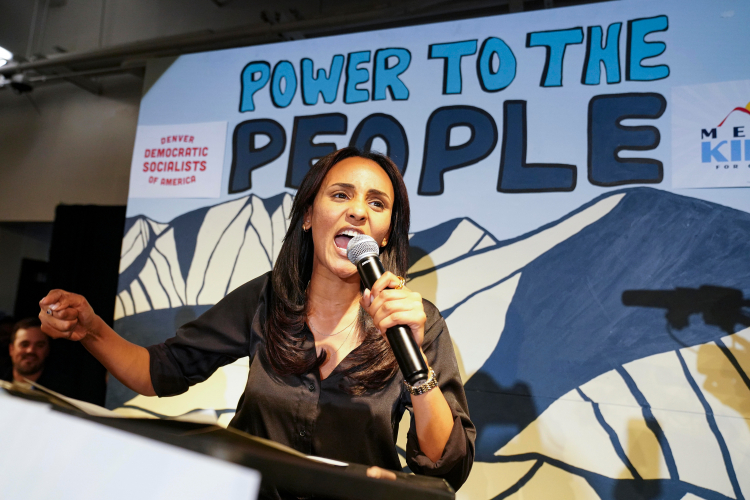
A small but loud cohort on the right has sought to put an America First spin on anti-Israel and what some see as antisemitic activism, in advocating against the U.S.-Israel alliance, railing against the so-called “Israel lobby,” and insinuating that Israel and pro-Israel Jews are manipulating U.S. policy to Israel’s benefit. American Priorities-supported Democratic nominee for the U.S. House from Colorado Melat Kiros, who says “there is no greater concern for me than ending the occupation, apartheid, and genocide in Palestine and guaranteeing Palestinians right to self-determination, statehood, the right to return, and reparations for Israel’s crimes,” has bemoaned that when the Democratic Party “refuses to lead morally on this issue, they are “leav[ing] a vacuum for those on the far right” and “letting antisemites on the right co-opt the movement for Palestinian liberation while giving fodder to AIPAC talking points.” But while prominent on the podcast scene and on social media, there are few successful candidates reflecting such views.
By contrast, as Waleed Shahid, former spokesman for the Justice Democrats and Bernie Sanders, now working for Mayor Mamdani, recently tweeted, “The politicians who were supportive of Uncommitted’s primary campaign (Mamdani, [New York congressional nominee Claire] Valdez, Darializa, Lander, Abdul, [Wisconsin Gubernatorial Candidate Francesca] Hong) are ascendant.” Among those candidates running since American Priorities’ establishment, it has supported all of the names referenced by Shahid save for Hong.
In the run-up to the U.S. Senate primary in Michigan, and specifically touting that race, CAIR launched a “Muslims.Vote” platform as a “one-stop hub for civic engagement.” It noted that “With more than 8 million Muslims in America and over 3 million registered voters, our community already has the power to shape elections, especially in key swing states. But millions more eligible Muslim voters must register, show up, and make their voices count.”
Hamawy and Chevalier are slated to serve as the keynote speakers at its forthcoming annual gala.
Meanwhile, American Priorities has made its ambitions clear. In a press release following El-Sayed’s victory, it wrote: “After a string of eight House victories this cycle, the Michigan primary marks the first direct statewide challenge to the Democratic establishment with national implications. El-Sayed’s win tonight will force a reckoning within the party over its backward-looking foreign policy and relationship to Israel – just as the contours of the 2028 presidential cycle come into focus.”