“I went on television to debate what makes a woman a woman. Four years later, I have a criminal conviction and face new charges that could put me in prison.”
Few debates today are as fraught as whether gender identity should override biological sex in law and public life. It turns on questions of women’s safety and fairness, and, increasingly, on free speech: what people are permitted to say, and what they can be compelled to say. Nowhere is that collision sharper than in parts of Europe, where speech deemed hateful or offensive can lead to criminal prosecution.
Dora Moutot, a French feminist writer and activist, was convicted earlier this year of “public insult” over remarks made during a 2022 televised debate with France’s first transgender mayor. She is appealing and now faces new criminal charges that could carry up to a year in prison. Below is her account of how a TV appearance became a criminal case, and what it reveals about the price of speaking freely in France today. —The Editors
In 2022, I went on a French television show to debate what makes a woman a woman. For expressing my opinion, I have been convicted as a criminal.
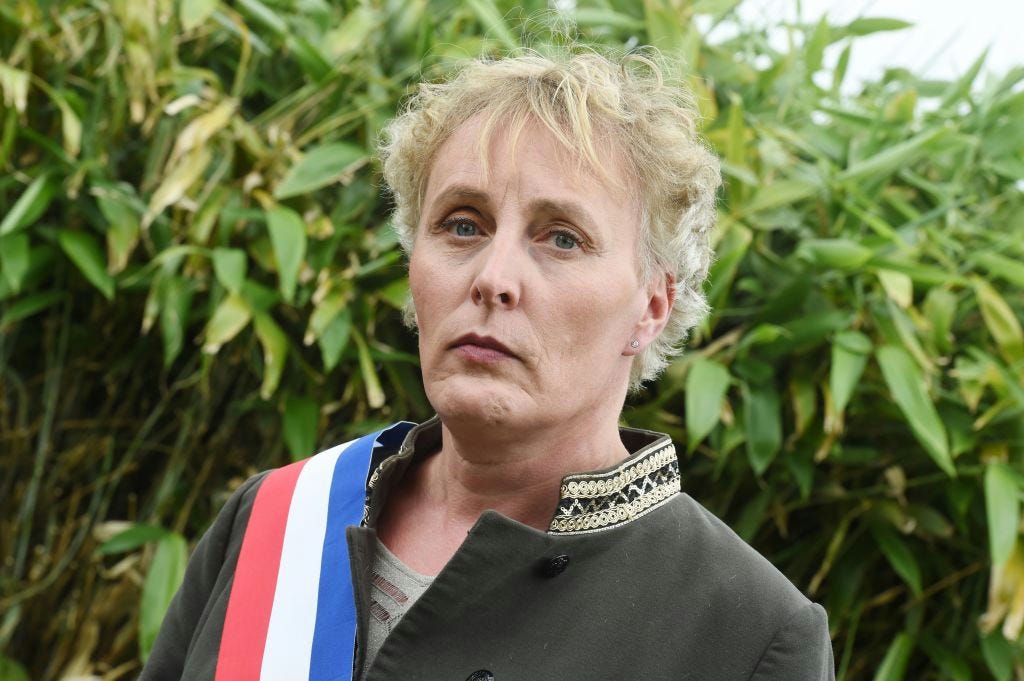
The show was Quelle Époque!, a popular talk show, and across from me sat Marie Cau, France’s first transgender mayor. I argued that self-identification laws were potentially dangerous to women. I cited cases of men identifying as trans women who were transferred to women’s prisons and later committed acts of sexual violence against female inmates. “I’m not saying that all trans people do this—far from it,” I said, “but, as women, we have no choice but to be wary of people with penises.”
When the moderator then asked whether I considered Cau to be a woman, I said that Cau “is a man, a transfeminine man.”
I never could have predicted what would happen next.
Two months after my appearance, three French LGBT nonprofits, all of which receive public funding, filed a criminal complaint against me, arguing these statements constituted a “transphobic insult” and could potentially drive many young transgender people to suicide.
In France, this isn’t a civil lawsuit in the American sense, where a private citizen sues another for money, and a judge decides who owes what. “Public insult” is a criminal offense, with a maximum punishment of one year in prison and a fine of up to €45,000 for insults committed against a person because of their sex, sexual orientation, gender identity, or disability. Under French law, private parties can initiate criminal prosecutions themselves.
France has a very different legal culture around speech than that of the United States. The First Amendment sets a very high bar for restricting speech, even hateful or offensive speech. But French laws are remarkably strict, even compared with European neighbors like the United Kingdom. Although the British government rolled back its speech laws to ensure that merely “insulting” language is no longer a crime, France maintains a lower criminal threshold. Public speech is deemed illegal if it is judged to be “any offensive expression, terms of contempt or invective that do not contain the imputation of any fact, when uttered publicly.”
Simply put, one does not need to make a false factual claim to break the law. If the court determines your intention was to harm someone, that alone can be enough to constitute a criminal offense.
When I learned that a criminal case had been launched against me for criticizing transgender ideology on television, I was shocked. I expressed my opinions in the context of a public debate, where disagreement is expected, and I didn’t think they would become the basis of a criminal case. What’s the point of a debate if you can’t actually disagree?
During the trial, which took place this past February, the prosecutor argued my opinion—that allowing trans women to use women’s spaces is dangerous—amounts to accusing all trans women, and all men, of being rapists (even though I explicitly clarified: “I’m not saying that all trans people do this”). That I warned women to “be wary” of men, he said, was an incitement to discrimination. He asked the judge to sentence me to a “civic awareness course” to teach me the “values of the French Republic”—essentially, a re-education camp.
The judge did not impose the course, but in May, I was found guilty of “public insult” and fined €4,754. The judge found that though my statements were made in the context of a debate, they constituted an “abuse of freedom of expression warranting the imposition of a criminal penalty commensurate with the harm thus caused to the values protected by our democratic society.” In other words, the judge concluded I intended to cause harm.
The truth is the opposite. My intention was not to hurt anyone; it was only to empower women to speak out against ideologies that undermine their rights.
Living through all of this has been surreal. Part of me finds it almost funny—absurd, Kafkaesque, tragicomic—like finding myself at the center of a bad circus. Some days I laugh at how I ended up here. Other days, I’m tired, disgusted, and exasperated. But this experience has also cured me of a certain naivety about the justice system and the tribal need for scapegoats or wicked witches to burn.
I’ve filed an appeal of the decision, which is still pending. But my legal troubles aren’t over.

In June, just weeks after my conviction, another LGBT organization filed six more complaints against me and my colleague Marguerite Stern. These new charges target specific statements we made on social media, our feminist blog, and our YouTube channel, Femelliste. They include our opinion that “men” were “demanding access to our spaces” and the question: “On what grounds should trans women’s fear of being mocked in men’s toilets take precedence over women’s fear of being raped?”
The complaints also target some of Marguerite’s posts on X, including one decrying the “celebration and glamorization of these disorders,” and another in which she argues that “under the guise of tolerance and inclusivity, we end up celebrating the mental disorders of people who are not well.”
Again, I am accused of public insult. If convicted, Marguerite and I could face up to one year in prison and a €45,000 fine. And if my first conviction is upheld, I could face a harsher sentence as a repeat offender.
I am fighting these charges because I should have the right to criticize transgender ideology and state the biological fact that women do not have penises and that males cannot become female. Even if others find those facts offensive, no court should punish me for saying them.

I came into this type of feminist advocacy by accident. Back in 2020, I was an Instagram influencer, running a popular account called T’as joui? (“Have you come?”) That explored female sexuality from a feminist perspective.
The account had hundreds of thousands of followers and soon became my primary source of income; I earned more through brand partnerships and content than I ever did before, as a lifestyle journalist. I wasn’t political—certainly not “right-wing,” as I’m so often labeled today. If anything, my work appealed to young liberal women fed up with inequalities between men and women in the bedroom.
On my account, I often discussed the female body. I shared testimonies from my followers about their sexual fantasies, partnered with dating apps to help my followers find partners, and shared information about female reproductive health and under-researched conditions like endometriosis and unexplained pelvic pain.
But in 2020 I started getting messages from transgender activists, demanding I be more “inclusive” in my commentary by including “women with penises” in my definition of “woman.” I refused, and explained that being a woman is a biological fact and that I didn’t think saying so should be controversial.
Word must have gotten around the trans activist community, because all of a sudden internet activists began labeling me as a transphobe and a TERF (trans-exclusionary radical feminist), a term I’d never even heard before. All of my brand partnerships—my main source of income—dropped me and refused to work with me again. They told me I had become too controversial.
Around this time, I met Marguerite, a fellow feminist activist who shared my concerns about the transgender movement’s growing power. In 2023, we started a blog called Femelliste, a mix of the words feminist and female, and a year later wrote a book called Transmania: Enquête Sur Les Dérives de L’idéologie Transgenre (“An Investigation into the Harmful Effects of Transgender Ideology”). Our goal was to shed light on what we saw as a vastly undercovered story—the rise of transgender ideology and its takeover of French institutions.
For example, in 2022, Le Planning Familial, France’s version of Planned Parenthood, stopped using the words “female” and “male” and began embracing terms like “women with penises.” The French Rugby Federation became the first sports body in the country to allow transgender women to compete in women’s leagues, and a government-appointed committee has since urged all French sports federations to adopt similar rules. Under President Emmanuel Macron’s watch, other state-funded institutions have systematically folded. Just last week, the French government posted on X that it will begin reimbursing menstrual pads for all “menstruating individuals.” To us, these are massive stories that nobody in the French media dares to cover, let alone criticize.

When we launched Femelliste, we published a manifesto arguing that admitting transgender women into women’s sports, prisons, and changing rooms on the basis of self-identification raises serious concerns about safety and fairness. We questioned whether the discomfort transgender women feel using men’s facilities justified the much graver risk of women being assaulted. Much of the language now cited against us comes from that document, and the context matters.
Take our concerns about toilets. Familles LGBT, the organization pursuing legal action against us, claims our words imply that all trans women are rapists. They don’t. In fact, we explicitly stated that “not all trans people are predators.” Our point was that self-identification policies can be exploited by bad actors, and that when two groups’ fears are in tension, women’s fears shouldn’t be dismissed.
The concern was grounded in real cases. When we wrote transgender women “have even raped female inmates” in prisons, we were referring to actual cases like that of Karen White, a transgender woman imprisoned for rape in the United Kingdom, who was later convicted of sexually assaulting two other prisoners. Numerous other cases in the United Kingdom and the United States have raised similar concerns.
On bathrooms, we pointed to cases like that of Katie Dolatowski, a transgender woman convicted of sexually assaulting a 10-year-old girl in the women’s toilets of a supermarket in Scotland. We did not deny that transgender women may fear being humiliated or assaulted in men’s bathrooms. But we argued that this vulnerability cannot be used to deny or dismiss the vulnerability of women and girls.
My words have been called violent. So perhaps I shouldn’t be so shocked by the death threats I receive. Strangers send me messages saying they want to slit my throat and kill me. My home address has been posted online. Once, while riding my bike, I noticed my brakes had been severed. I believe someone found my home and cut my brakes, either to intimidate me or hurt me.
My experience is just a case study within a larger trend. The groups that first brought charges against me have taken others to court over what they call transphobic speech.
I filed six complaints to the police. They said they investigated, but told me they haven’t been able to track anyone down.
Public appearances now come with a real risk of harassment and intimidation for both Marguerite and me. During a signing on our 2024 book tour, a gang of masked protesters gathered outside, prompting the police to step in and protect us. At one conference where Marguerite was scheduled to speak, vandals set fire to the venue, using what appeared to be a small explosive device. Later, hundreds of trans activists showed up to protest her appearance, and police said they couldn’t find those responsible for planting the device.
Today, I no longer trust the French justice system to protect me. It moved against me with remarkable energy over a sentence spoken on television, while the people threatening to kill me face no consequences. It feels as if, in France today, free speech exists only for those who hold the “right” views—and transgender ideology is protected by authorities, while anyone who is threatened for dissenting is abandoned.

Our case asks a question that goes beyond France: What happens to democratic debate when disagreement over sex and gender is settled in court instead of in universities, newspapers, and political institutions?
My experience is just a case study within a larger trend. The groups that first brought charges against me have taken others to court over what they call transphobic speech. They sued a conservative group over a post on X saying gender transition had no place in schools; in September 2024, a Paris court rejected the complaint. They sued a magazine over a 2021 cover story on the “transgender delusion.” That case was scheduled for a hearing in October 2025, and no judgment has been reported. And, joined by other LGBT associations, they also filed a complaint against the politician Marion Maréchal after she wrote, when transgender actor Karla Sofía Gascón received the Best Actress prize at Cannes in 2024, that the award had gone to a man. That complaint, too, has not produced a reported decision.
The problem isn’t confined to France. In Britain, police arrested comedy writer Graham Linehan at Heathrow in 2025 over X posts about trans women in women’s spaces. In Scotland, the feminist campaigner Marion Millar was charged over social media posts deemed transphobic. Even in the United States, the Department of Justice prosecuted Dr. Eithan Haim after he leaked records showing that a hospital was still giving minors puberty blockers and cross-sex hormones after saying it had stopped. All three cases were later dropped, but each defendant spent months under threat of prosecution, and the message to everyone was clear: Speak at your own risk.
The central issue in cases like ours is where French courts draw the line between unlawful speech directed at people and legitimate political criticism of ideas, policies, and social movements. For feminists who argue that biological sex matters in law and public policy, that distinction—between attacking a person and criticizing an idea—is fundamental. But it seems the courts in France don’t see it.
The consequences are chilling. Can a woman in France now no longer publicly say that sex is biological? Can she argue that male prisoners should not be housed in women’s prisons? Can she discuss the risks of allowing male-bodied people into certain female-only spaces? Can she criticize gender-identity ideology as a political doctrine without that criticism being treated as hostility toward transgender people as a protected group?
The goal of these lawsuits is to silence us, and unfortunately, it’s working. I’ve realized going on national television in France to share my perspective is simply no longer viable; the risks are just too high. I’m terrified of going to prison and being financially ruined, and I believe every woman who shares my views has gotten the same message: It’s better to stay quiet than risk what comes with speaking out.
I am one of the lucky ones. I was born in the United States and hold an American passport, though my parents are French and I have spent almost all my life living here in Paris. I’m now contemplating leaving France altogether and moving to the U.S. Speaking out in the American press feels like a risk worth taking. I believe American readers will care about what’s happening here, and if enough people are outraged, the pressure might move the needle in France.
France calls itself a democracy. But what kind of democracy threatens people with jail time for stating basic facts?